
Tin Computer
Tin Computer agentically optimizes your product by autonomously running growth experiments, fixing bugs, and shipping improvements around the clock.
Visit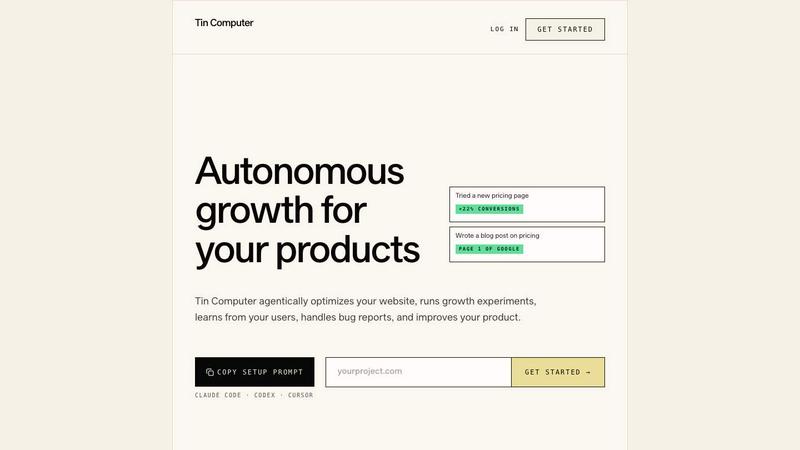
About Tin Computer
Tin Computer is an autonomous AI growth agent purpose-built for small SaaS teams looking to drive organic, sustainable growth without increasing headcount or ad spend. Rather than serving as a passive analytics dashboard or a content suggestion tool, Tin Computer actively connects to your existing software stack—including GitHub, Stripe, Google Analytics, Search Console, PostHog, Sentry, and Vercel—and ships real, code-level changes directly to your project via pull requests that you review and merge. It functions as a continuous growth playbook, working across four core areas: organic SEO (blog posts, comparison pages, technical fixes), product engineering (bug fixes, small features, onboarding tweaks), analytics (funnel diagnostics, cohort analysis, experiment tracking), and user research. The agent operates autonomously: it reads your funnel to identify what is slowing growth, builds and ships the fix or experiment from start to finish, then watches the result, keeps what worked, and picks the next move. This creates a self-improving loop that runs 24/7, eliminating the need for a dedicated growth team or a static roadmap. Tin Computer is designed for founders and small teams who want to reclaim their time while still seeing consistent, compounding improvements to their product and revenue. A notable case study involves Claw Messenger, a dormant side project that grew from $480 to $13,500 ARR and from 4 to 146 paying customers in just 112 days after turning on Tin Computer. It is best suited for web-based SaaS products, marketing sites, indie dev tools, marketplaces, and applications built with frameworks like Lovable, Bolt, or Replit.
Features of Tin Computer
Autonomous Growth Loop
Tin Computer operates on a continuous three-step cycle that requires no manual intervention. First, it reads your funnel and analytics to find what is slowing growth down. Second, it builds and ships the fix or experiment from start to finish by opening a pull request on your GitHub repository. Third, it watches the result, analyzes the outcome, and then picks the next most impactful move. This loop runs indefinitely, ensuring that your product is always being optimized without you needing to write a roadmap or prioritize tasks.
Multi-Specialist Agent Team
Behind the single Tin Computer interface, a team of specialized AI agents works in parallel, each owning a specific growth lane. These agents include a Strategist, Research Analyst, Organic Growth Engineer, Paid Acquisition Engineer, Sales Outreach agent, Product Analyst, Financial Analyst, Product Engineer, and Customer Support Engineer. This architecture mimics having a full growth team without the overhead of hiring, training, or managing human employees. Each specialist focuses on its domain, allowing for deep, high-quality work across SEO, product, analytics, and support simultaneously.
Deep Integration with Existing Stack
Tin Computer plugs directly into the tools your team already uses, eliminating the need for new software or complex setup. It connects to GitHub for code changes and pull requests, Stripe for billing and pricing experiments, Google Analytics and Search Console for traffic and SEO performance, PostHog for product analytics and cohort tracking, Sentry for error monitoring and bug fixes, and Vercel for deployment. This integration allows Tin Computer to read your data, understand your product's state, and ship changes that are contextually relevant and technically sound.
Real Code and Content Shipping
Unlike tools that only generate recommendations or reports, Tin Computer actually ships real changes to your product. It writes and opens pull requests for bug fixes, small features, onboarding improvements, SEO blog posts, comparison pages, pricing experiments, and technical fixes. You retain full control by reviewing and merging these pull requests. This feature ensures that growth work is not just planned but executed, moving from insight to impact without waiting for a developer or content writer to become available.
Use Cases of Tin Computer
Revitalizing Dormant Side Projects
Many founders have side projects that have plateaued or been abandoned due to lack of time or resources. Tin Computer can be pointed at these projects to autonomously run growth experiments, fix bugs, improve SEO, and engage with users. The Claw Messenger case study demonstrates this perfectly: a project with only $480 ARR and 4 paying customers grew to $13,500 ARR and 146 customers in 112 days. The agent launched a referral program the same day a user asked for one and created a reseller tier the day after another customer expressed interest, showing real-time responsiveness.
Continuous SEO and Content Optimization
For SaaS teams that struggle to maintain a consistent content and SEO strategy, Tin Computer acts as a dedicated organic growth engineer. It writes and publishes blog posts, creates comparison pages, and implements technical SEO fixes directly through your GitHub repository. It monitors Search Console and Google Analytics to identify ranking opportunities, content gaps, and technical issues. This eliminates the need for a separate content calendar or SEO specialist, as the agent continuously optimizes your web presence based on real performance data.
Automated Product Experimentation
Tin Computer runs growth experiments on your product without requiring a product manager or engineering time. It can test pricing changes, trial length variations, onboarding tweaks, headline rewrites, and referral discounts. Each experiment is shipped as a pull request, and the agent tracks the results to determine what works. This allows small teams to run dozens of experiments over a few months—far more than a manual team could manage—leading to cumulative improvements that compound into significant revenue growth, as seen in the 33.6% improvement demonstrated in the product comparison chart.
Data-Driven Bug Fixing and Feature Development
By integrating with Sentry and PostHog, Tin Computer identifies the most impactful bugs and small feature requests based on user behavior and error frequency. It then writes the code to fix these issues and opens pull requests for review. This ensures that your product is constantly being improved based on actual user pain points rather than assumptions. The agent also handles customer support emails, learning from user feedback to inform future experiments and fixes, creating a closed loop between user needs and product evolution.
Frequently Asked Questions
What types of projects does Tin Computer work with?
Tin Computer works best with web-based SaaS products, marketing sites and blogs, indie developer tools, marketplaces and directories, and applications built with frameworks like Lovable, Bolt, or Replit. These projects live on the open web and have code you control in a GitHub repository. It does not currently support mobile apps, native desktop applications, drag-and-drop no-code platforms like Bubble or Webflow, or Shopify and Etsy stores. If your product is a web application with a GitHub repository, Tin Computer is likely a good fit.
How does Tin Computer ship changes to my product?
Tin Computer connects to your GitHub repository and ships changes by opening pull requests. It writes the code for bug fixes, new features, onboarding improvements, SEO content, pricing experiments, and more. You retain full control by reviewing and merging these pull requests at your own pace. This means you can see exactly what is being changed, ensure quality, and decide when to deploy. The agent does not deploy directly to production without your approval, maintaining safety and oversight.
What happens if I want to stop using Tin Computer?
You can cancel your subscription at any time, and there are no long-term contracts. If you cancel, Tin Computer will stop shipping new pull requests and analyzing your data. However, all the changes it has already made to your product remain in place because they were merged into your codebase through standard GitHub pull requests. You keep all the improvements, content, and experiments that were shipped. There is no lock-in, and your data stays with you.
How fast can I expect to see results with Tin Computer?
Results depend on your product's current state and the plan you choose. The Standard plan ships up to 30 tasks per week, while the Unlimited Growth plan ships an unlimited number of tasks. In the Claw Messenger case study, significant ARR growth was observed within the first 92 days, with the project going from $480 to $11,580 ARR. The agent works continuously, so improvements compound over time. Most users see measurable changes in traffic, conversion rates, or revenue within the first few weeks as the agent identifies and addresses the most impactful growth blockers.
Pricing of Tin Computer
Tin Computer offers two straightforward pricing plans, both of which include access to all features and the full team of specialized agents. The Standard plan is priced at $99 per month and includes up to 30 tasks per week. The Unlimited Growth plan is priced at $299 per month and provides an unlimited number of tasks per week. Both plans allow you to cancel at any time. You can move up or down between tiers whenever you need. For a detailed comparison with manual growth work and to see where Tin Computer fits before hiring a growth team or agency, you can view the full pricing page and comparison guides on the website.
Similar to Tin Computer

Slide-Easy
A Mac app that turns your App Store link into a week of Instagram Reels and carousels, written from your real reviews.

Product Launch Checklist
A free launch checklist for SaaS, apps, AI tools and more. Every step says why it matters and when you can skip it.

Forms Plugin
The #1 Native Form Builder Plugin for Framer - No Code, No Embeds, No External Platforms.

ContextBolt SEO
Research keywords, competitors, backlinks and AI visibility in Claude or Codex. Keep the findings in your SEO dashboard.


iHatePosting
Create once, tailor for each platform, and schedule posts across 14 social networks from one simple dashboard.


UGCad AI
AI UGC video ad Generator which Turn a URL, prompt, or template into a ready video ads